"Static"
Season 2, Episode 10, Written by Charles Beaumont, Story by Ocee Ritch

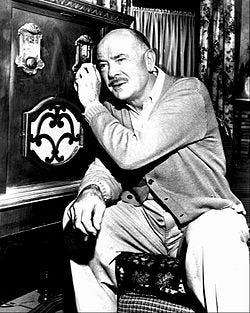
(Ed Lindsay, played by Dean Jagger)
Ed Lindsay, a cantakerous and embittered bachelor in his late fifties lives in a boarding house. He is repulsed by televison. Therefore, he goes downstairs to the basement to retrieve his old radio and sets it up in his room. Lindsay promptly finds out that it plays old radio shows from his past that only he can hear when he is alone. Vinnie Broun, an old woman to whom he was once engaged, believes that he is “going mad” from the radio, which he alone can hear. She believes that Ed has become bewitched in a way to become overly nogalistic for the “good old days” when they were a younger and happier couple. This of course happens when Lindsay is merely in the presence of the old radio. Lindsay doesn’t believe this to be the case at all, and he secludes himself in his room alone with the radio. Broun, concerned for his mental health, sells his radio to a pawn dealer. Enraged, Lindsay goes down to the shop, gets his radio back, and prays that it still works. It does, in fact, work. When he asks Broun to come into his room and hear the radio, it is a spry and kinder version of Broun who appears as if she had just lept out of the fountain of youth. Somehow, the radio acted as a time machine, the year became 1940 and, Lindsay, of course, reverted to becoming a young man himself. It seems as though he was given a second chance.
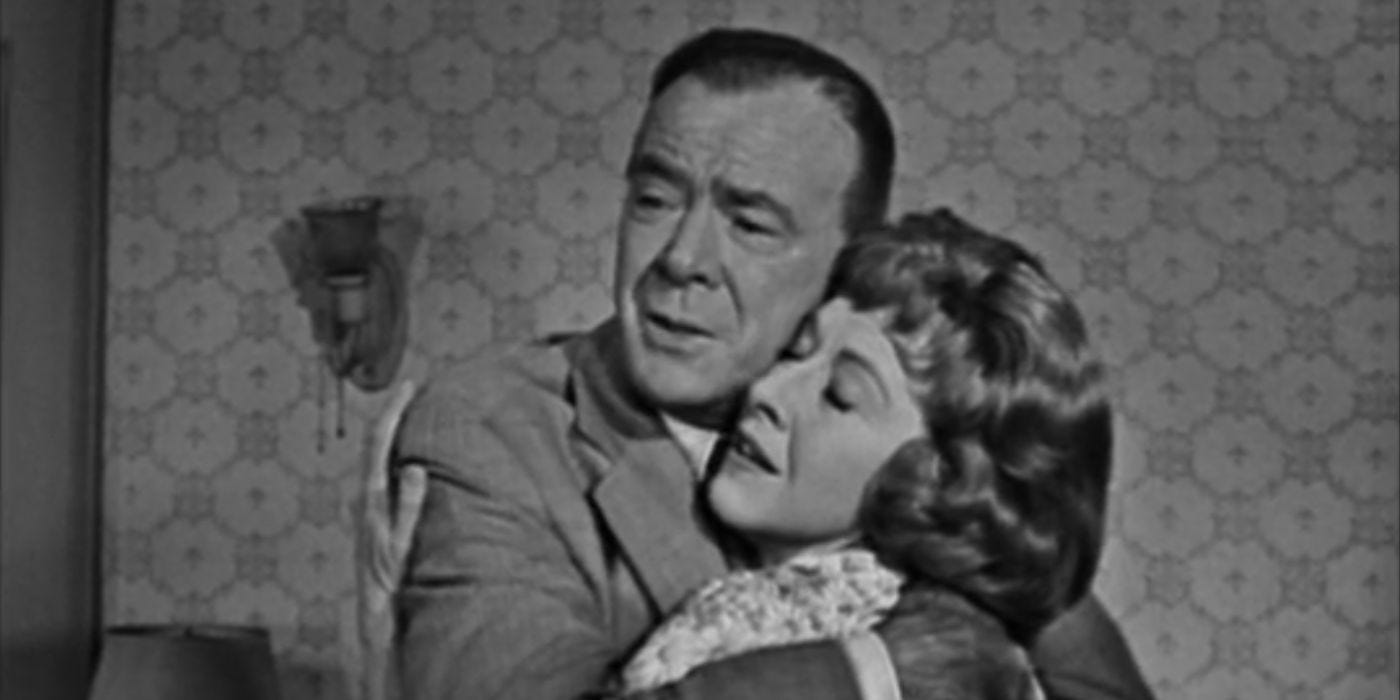
(The Younger Couple, Ed Lindsay (Dean Jagger) and Vinnie Broun (Carmen Mathews))
Before I move into the “end of life” bit, I just want to share my two cents about the episode as a whole. I love the idea of it, but honestly, it just falls flat for me. There are several episodes of The Twilight Zone where I don’t like any of the characters. This is one of them. I don’t dislike any of them to root for their demise. For me, they are just kind of there. So, assuming I had a metric to measure this episode by, it would be a bottom tier episode for me.
Now with that out of the way, here’s how I see its connection to hospice:
Many of the patients that I work with in hospice are dementia patients in nursing homes. If one had replaced “boarding house” with “nursing home,” this episode would make total sense. In my regular working day, I get to go on many imaginary and fantastical trips with patients. Many of these imaginary situations are bolstered by their desire for the past. Patients with dementia have very little short-term memory left (if any at all), but the long term memory remains. Unfortunately, by the time I see them, most of the speaking ability has diminished, and I get more expressions of feelings via “world salad” and fragmented and spliced prior conversations and memories. Should we assume that Mr. Lindsay (sadly, like this piece’s author, Charles Beaumont, who had the onset of Alzheimer’s at age 34 ) was beginning to have some kind of cognative decline, it may have looked like this. Whether or not the radio had magical powers is less important. Studies have shown that dementia patients benefit from music and music therapy. It can be a powerful tool when it comes to dementia patients who are suffering from depression and anxiety (Music Therapy in the Treatment of Dementia: A Systematic Review and Meta-Analysis).
As a chaplain, I use music with my patients often. It is amazing to see someone go from being grumpy to singing along with me full gusto and happy. Sometimes, I’ll sing a song in Hebrew or Yiddish to a patient who is Jewish, and they’ll cry. I don’t get upset. Perhaps it is a happy cry, or it’s a cathartic cry. Imagine having all kinds of feelings pent up and not being able to explore them or even name them. Music helps heal the soul quite literally. Imagine a woman who has gone to church every Sunday for her whole life up until now. Imagine what singing “How Great Thou Art” with her does to her spirit. She hasn’t forgotten the words. In fact, it is just about the only thing she can speak that isn’t jumbled.
(As a side note for the curious: Yes, I am a rabbi. However, I am also a multi-faith chaplain. I act as the voice for those who have none, so in my theological understanding of my faith and in my work as a multifaith chaplain, I have no problem with this).
Mr. Lindsay, a cantankerous middle aged man with delusions of a better time and a radio stuck on station “schmaltz.” Perhaps, he becomes kinder due to his cognitive decline (it does happen) and the music he imagines. Perhaps he sees Ms. Broun as she once was when he loved her. Whether that is sweet or sad, endearing or illusive, one thing is for sure, cognitive decline is not just contained within the four walls of The Twilight Zone.
I always kinda liked this episode. It’s the war ones I usually skip.
I love reading about seniors. In another life I worked in a facility once upon a time and always fell hard for the Alzheimer and Dementia patients, which were most of them. Some were indeed cantankerous but most just pulled at my heart strings.
Beaumont wrote "Static" in 1960. Two years before anyone noticed something was wrong with him. He wrote a character who hears things nobody else hears. And everyone around the guy decides he's lost it. Then that exact thing happened to Beaumont, except it wasn't radio signals. It was his own mind getting harder to hold onto. His friends ghostwrote for him. He still split the fee.
You put him in parentheses, but he might be the whole episode. The Vinnie part is sharp, in hospice terms that's the family selling the radio. Original title was "Tune in Yesterday." Beaumont stole it for his own essay.